Economics for Health Presents New Research on Illicit Tobacco, E-Cigarettes, and Cannabis Retail at SRNT 2026
Earlier this month, three team members from Economics for Health participated in Society for Research on Nicotine and Tobacco's (SRNT) 2026 Annual Meeting and presented their latest research on tobacco use, e-cigarettes, and cannabis. The studies examined how policies shape youth substance use and whether common assumptions about illicit tobacco trade hold up against the data.
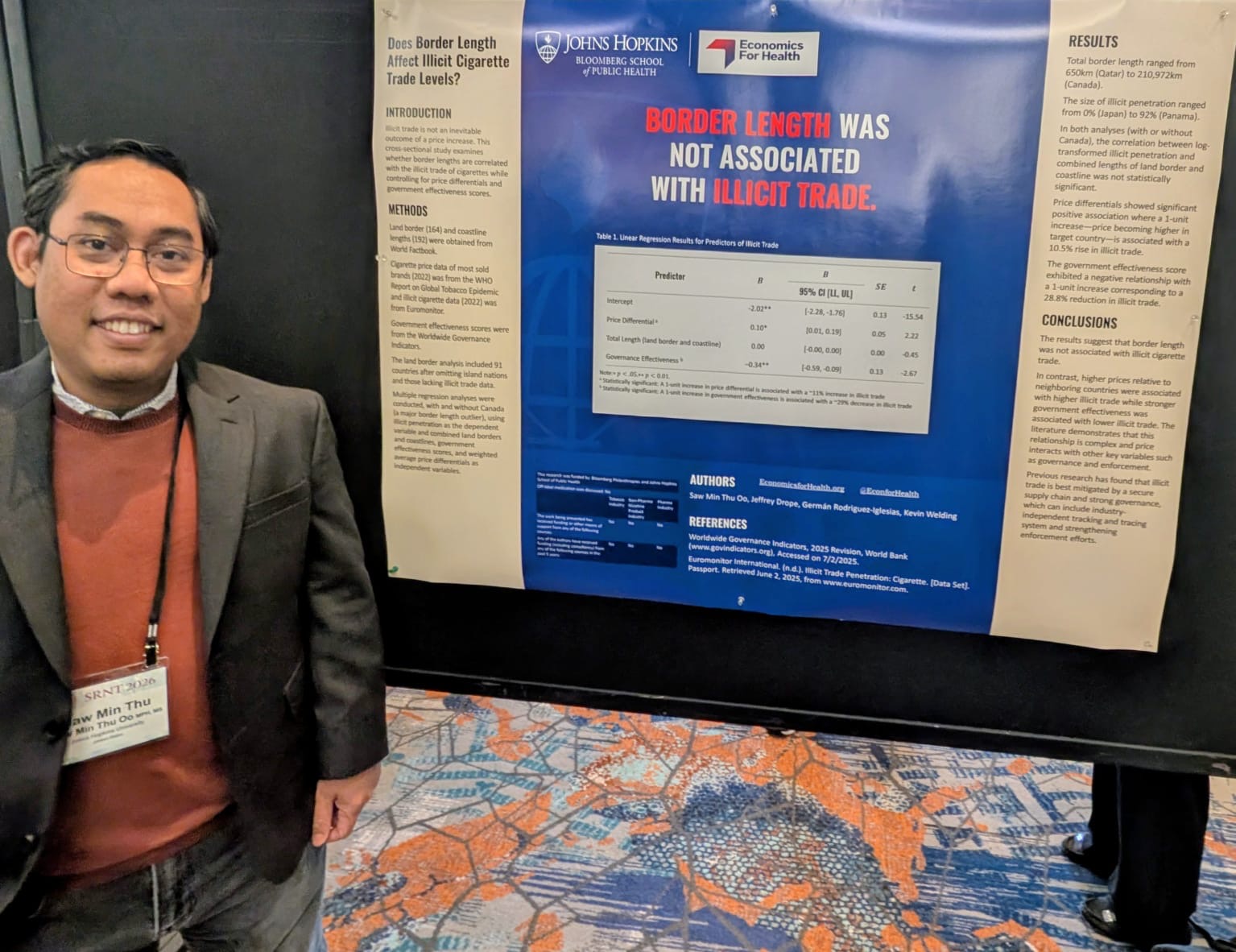
Research Analyst Saw Min Thu Oo presented a study challenging the widely repeated claim that countries with longer borders face higher levels of illicit cigarette trade. This assumption appears frequently in industry arguments against tobacco tax increases and in policy discussions about trade enforcement. The research team examined whether border length predicts illicit trade levels using data from 91 countries, combining border and coastline measurements with cigarette price data, illicit trade estimates, and governance indicators.
The analysis found no significant relationship between border length and the volume of illicit cigarette trade. What did matter, was price differentials and government effectiveness. A one-unit increase in price differentials was associated with a 10.5% rise in illicit trade, while a one-unit increase in government effectiveness corresponded to a 28.8% percent reduction. The findings point to secure supply chains and strong governance as the key factors at play, not geographic features, and suggests that countries should focus policy attention on enforcement capacity and reducing corruption to diminish illicit trade.
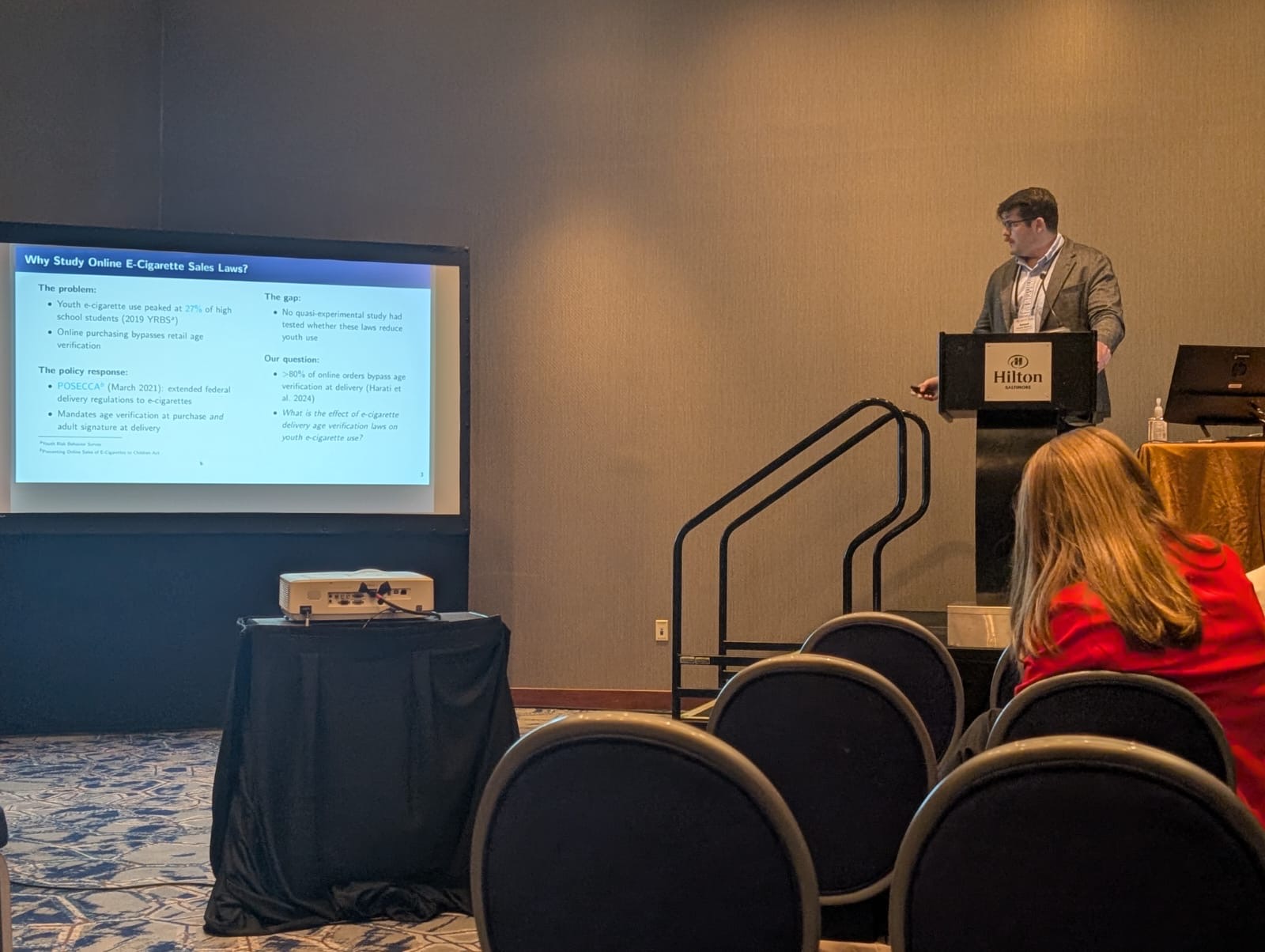
Economist Sam Sturm presented findings on online e-cigarette delivery sales laws and their effect on youth vaping. The study examined whether state-level restrictions requiring age verification for online sales, and the subsequent federal law that standardized these rules nationwide in March 2021, reduced youth access to e-cigarettes. Using Youth Risk Behavior Survey data from 2015 to 2023, the researchers compared outcomes in states that gained delivery sales laws through the federal Preventing Online Sales of E-Cigarettes to Children Act with states that already had such restrictions in place.
The analysis found that implementing delivery sales laws with age verification requirements was associated with a 2.6 percentage point reduction in current e-cigarette use among youth in states that previously lacked these restrictions. Online sales have become an increasingly viable pathway for youth to obtain e-cigarettes, and the findings suggest that closing this channel through policy can effectively reduce use rates.
Economist Amit Summan presented research examining how the speed of recreational cannabis retail rollout affected adolescent substance use intensity. As states legalized recreational cannabis, they have varied widely in how quickly retail infrastructure followed—some opening stores within months, others leaving a gap of several years. Using Youth Risk Behavior Survey data on high schoolers spanning over a decade, the analysis compared states that quickly opened stores after legalization to states that had not yet legalized recreational cannabis.
Contrary to concerns that quick retail availability might drive more intense teen substance use, the research found that rapid retail rollout was associated with lower daily cannabis use among teen users—and was not linked to increases in daily use of alcohol, cigarettes, or e-cigarettes. These declines were concentrated among female adolescents, while heavy-but-not-daily use rose among this group, suggesting complex shifts in use patterns rather than uniform declines. Ongoing work is needed to explore how these policies affect overall use prevalence and polysubstance use patterns.
Together, these studies reflect EfH's approach of using rigorous empirical methods to evaluate how policy design affects public health outcomes, with the goal of establishing evidence to inform more effective policies. The team is continuing to explore timely and relevant questions regarding tobacco, e-cigarette, and cannabis use in the United States and around the world.